Volunteer recruitment: a good choice, not a hard sell

Big brands are well aware of the power of choice. They invest serious money in the brand, the look, the positioning of products on a shelf, and the campaigns that “support” us in choosing them. How to become the top seller features regularly in corporate boardrooms, and that behavioural understanding can turn a conscious choice into a habit. Charities rarely have that budget, but the psychology applies to us too, and it matters most when asking someone to give their time.
How we really make decisions
Consciously and unconsciously, we are all affected by bias when we make decisions. Take a busy café, a bustling hive of activity with laughing faces and few free tables, sitting next to an empty but cheaper one. A few people may be drawn to the quiet café, but most of us are pulled towards the busy one. They must be good if they’re that busy! If no one wants the cheap cake and coffee next door, it can’t be any good. I hope they can squeeze me in, and if it’s good I’ll come earlier next time.
What pulls us in includes social proof, the way we frame choices to find the “best” option, and the fear of losses if we choose wrongly.
The rational choice vs the emotional choice
Choosing a job can be both a rational and an emotional choice. For many people, “I need a job to pay the bills” is the main reason for applying, whatever they feel about the role. The classic interview question, “Why have you applied for this job?”, is really looking for the emotional pull towards an organisation and the difference a person feels they can make.
Volunteering asks for both at once
- The rational questions: Does this fit with who I am? Do I have time for this? What do I know about this organisation and its mission?
- The emotional questions: What will I get from this? What difference can I make? Who else volunteers here? Will I enjoy it?
A volunteer recruitment message that answers only one set of these questions is working with half the picture.
A shop front on the high street
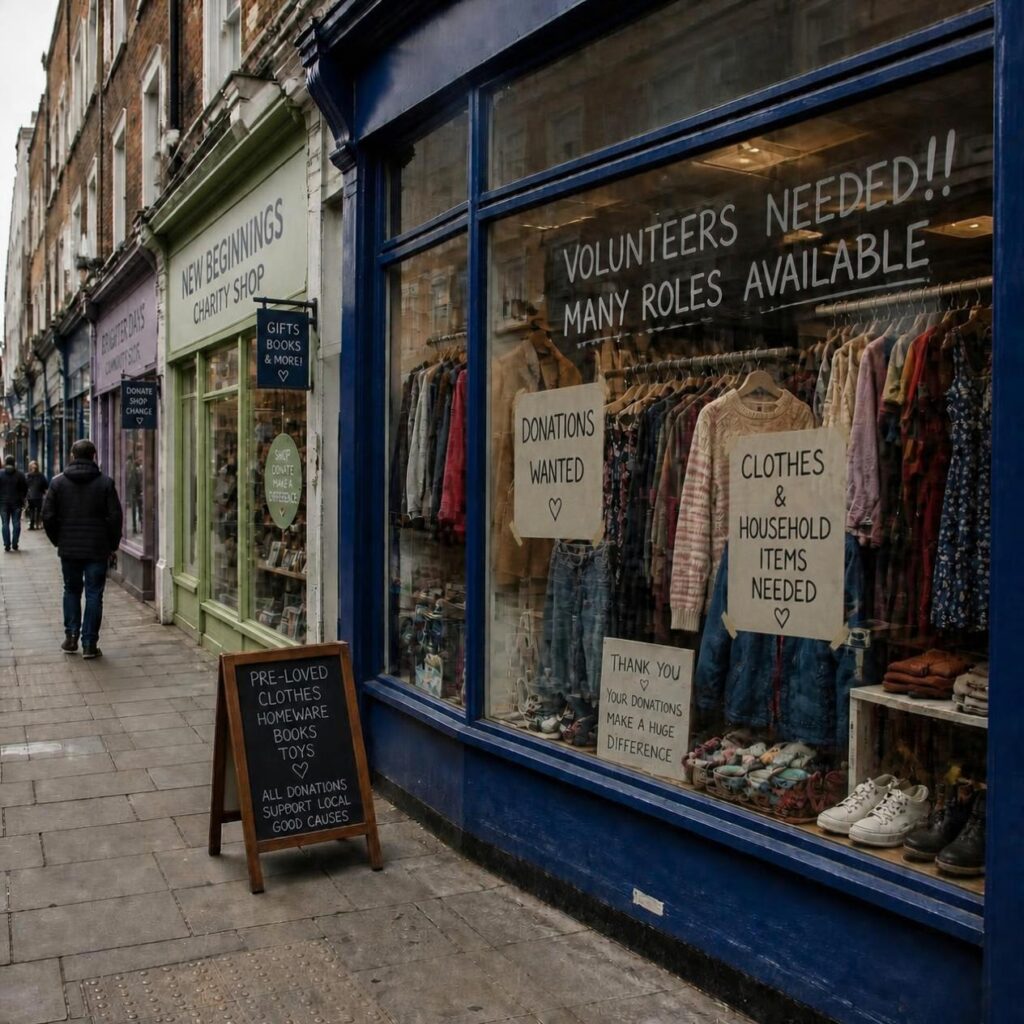
Today I saw a charity shop front much like the one in the image, with a window sign like this asking for volunteers. There were several other charity shops on the same street, and the sign got me thinking about how we ask.
To be clear, I’m not criticising, I’ve worked in charity retail. I understand the pressures first hand and I know the sign will have been written by those who care about keeping the doors open. Anyone who has worked in volunteer management knows how hard recruitment can feel, and I’m sure I’ve written appeals in the same spirit.
Most new choices we make take time. We are swayed by rationale and bias. A sign like this may work for a small number of people. Some might go home, think about how the sign made them feel, and venture in at some point to see if they can help. But they would most likely see it as helping out an organisation in need, rather than joining an organisation that is making a terrific difference. A decision made without any sense of “what’s in it for me” is likely to result in low retention. Let’s face it, none of us are superheroes, happy to help others long term without finding some true personal gain.
The statement “Many roles available” – also adds additional levels of decision making complexity. That paradox of choice, an overwhelm of options.
What could the window say instead?
Firstly recruit for one or two at a time, understand which ones are more critical to smooth operations.
Here is how the same appeal might look with the decision-making in mind.
Before:
VOLUNTEERS URGENTLY NEEDED. We can’t stay open without you. Please help!
After:
Love making a difference? Appreciate great customer service? Join our Saturday volunteer team.
Make sure current volunteers are aware of what the opening is and encourage them to share it amongst their networks. Have further information easily available inside and through other forums such as local social media.
Behavioral insights – the greatest leaver in volunteer recruitment?
Great recruitment and retention is about much more than luck and hoping a volunteer walks past the shop and wants to do a good turn. It’s about understanding decision making, the triggers that engage people, and what keeps a community thriving.
That expertise is most valuable at the start. When someone says “we need more volunteers”, a senior person with volunteering insight should be in that conversation. The answer “more volunteers” rarely solves the problem unless someone has asked why they’re needed and what they’ll do. Root cause analysis works well here, yet many volunteer managers have been handed that instruction with no background at all.
Looking beyond your own needs
Corporate Social Value teams want to evidence long-term social impact through their donations of time and money, and charities are sitting on this in bucketloads. The benefits of volunteering reach well beyond the charity’s mission, for society and often for the individuals themselves. For grant sourcing and corporate fundraising, that evidence is a real asset.
When you’re working on a shoestring, it is hard to look beyond your own immediate needs. That’s exactly why Theory of Change discussions should include someone from the volunteering team. They can explain the rationale for recruitment, make sure the language and messages are consistent across the charity, and set out from the start what the long-term impact will be and what’s in it for the volunteer.
Recruitment and Retention: building a community people want to stay in
The best recruitment is well planned, timely, led by volunteers talking about their own experience, and clear about the benefits for volunteers. The best retention comes from a community people want to belong to, where they can see the value they add and feel the wellbeing and purpose that come with it. Volunteering should be something you’re proud of.
One small thing to watch is the well-meant phrase “we couldn’t do it without you”. It’s said with real gratitude, and I’ve heard it from wonderful organisations. But it can carry an unintended undercurrent: I can’t step back, because they can’t manage without me. Thanking people for the difference they make, and naming it, says the same thing without the weight.
Avoid knee-jerk reactions to “we need more volunteers”, and don’t brush over retention issues. Much of the investment needed is time and expertise: the thinking, breaking down silos, and asking honestly, “Why would a volunteer want to give their time to us?”
Volunteers aren’t free
Nothing is really free, and that includes volunteering. A volunteer doesn’t come with a salary, but they shouldn’t be compared to one. If they are, the question becomes “shouldn’t this be a paid role?”, and no volunteer manager wants to be there. From the very first moment someone says “we need more volunteers”, it should be understood that this takes resources and insight.
A good choice, not a hard sell
We’re rarely persuaded by pressure or urgency. We say yes when we can see what we’d be doing, what difference it would make, and that it’s a commitment we can actually keep. Volunteering is no different. Nobody wakes up wanting to fill a gap on a rota, but plenty of us want to be part of something that matters.
Thanks for reading. In prepping this I read the following which you may also find useful:
https://www.thinknpc.org/resource-hub/ten-steps/
https://medium.com/@mondal05priti/the-psychology-of-decision-making-why-we-choose-what-we-choose-a2e8d7bd68a4
https://turtl.co/blog/the-psychology-of-choice/